
PI Innovation Award 2026: New Sensor Optimizes Sign Language Recognition
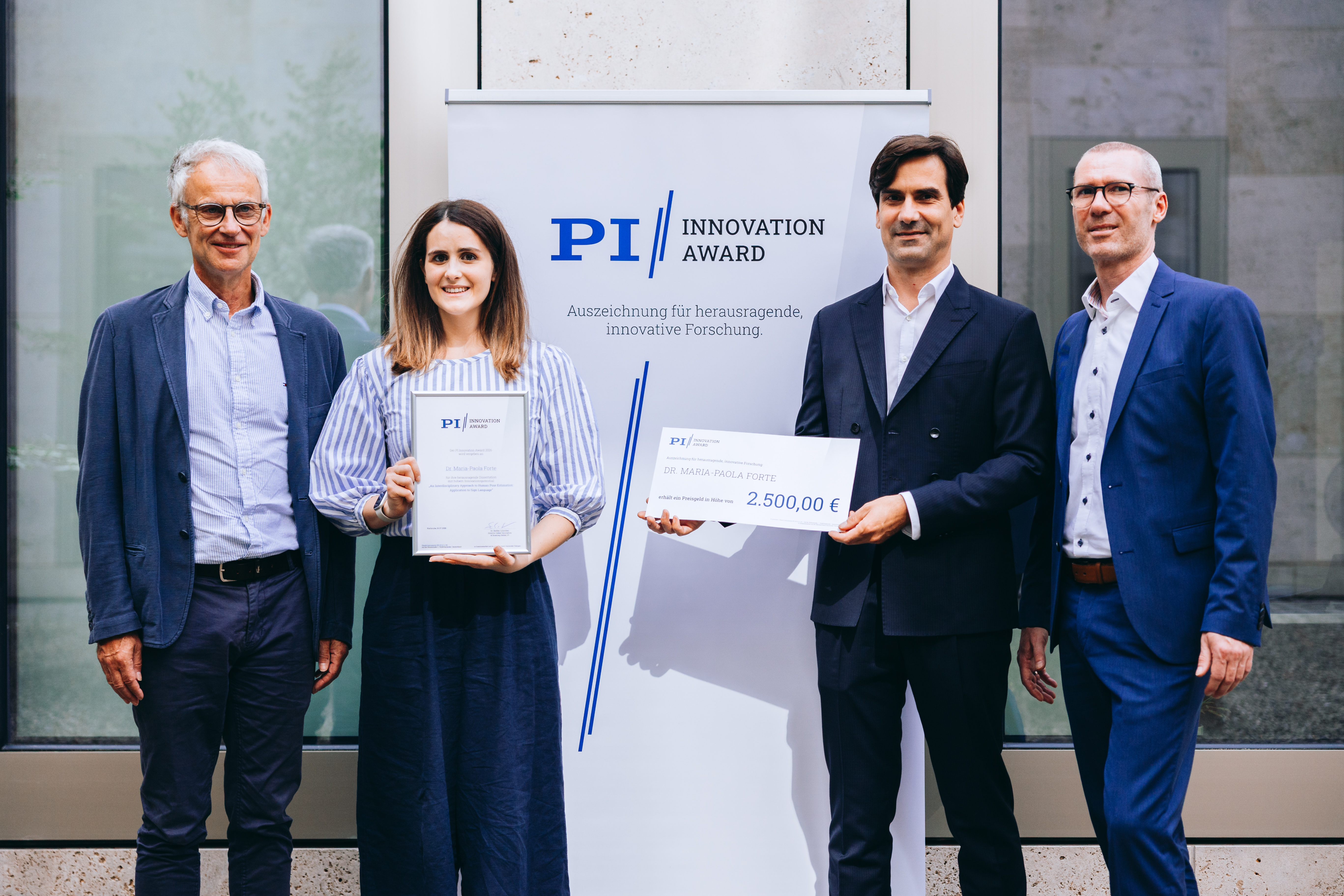
Photo from left to right: Prof. Dr. Thilo Stehle (Dean of the Faculty of Mathematics and Natural Sciences), Dr. Maria-Paola Forte (Award Winner), Dr. Markus Simon (Manager Strategic Innovation & Technology at PI), Dr. Steffen Schreiber (Director Global Innovation & Scouting at PI)
For the third consecutive year, PI has presented the PI Innovation Award at the University of Tübingen. This year's award goes to Dr. Maria-Paola Forte, a researcher at the Max Planck Institute for Intelligent Systems in Tübingen, for developing a novel sensor to improve the automatic recognition of sign language. The technology is intended to make digital services more accessible for deaf people—for example, through more natural sign language avatars and more accurate automated translation.

Technological innovation creates the greatest value when it improves people's lives. Dr. Maria-Paola Forte's work is an impressive example of how outstanding research can foster inclusion. This is exactly the type of innovation the PI Innovation Award aims to promote.
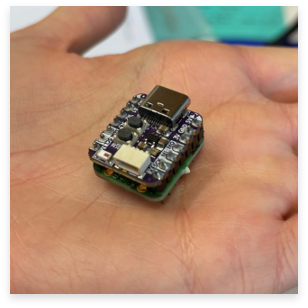
The device is worn like a bracelet and reliably detects when the hand makes contact with the face or another part of the body. It is based on a simple physical principle: when the hand touches the face or another body part, the electrical resistance between the points of contact changes in a measurable way. Unlike camera-based systems, the sensor does not need to see the contact—it directly detects whether skin-to-skin contact has occurred. This significantly improves the precision of motion capture, especially for signs in which the distinction between real physical contact and near contact is meaningful. Combined with camera-based tracking, the technology generates significantly more accurate motion data. It improves the automatic recognition and rendering of sign language while opening up new possibilities for accessible human-computer interaction.
Dr. Maria-Paola Forte has closed a critical gap in camera-based human motion capture. By introducing her sensor, she complements optical methods with information that cameras alone cannot reliably capture. By combining these different measurement approaches, she has created a solution with strong scientific and technological impact.
It was this far-reaching impact beyond academia that distinguished the researcher from a highly competitive field of applicants.
Dr. Maria-Paola has successfully brought her research from lab into practice: a patent application has been filed, the new sensor is already in production, and the work has led to a spin-off company.
Contact: Dr. Markus Simon, Strategic Innovation and Technology Management, and Dr. Steffen Schreiber, Director Global Innovation & Scouting